
Course Outline
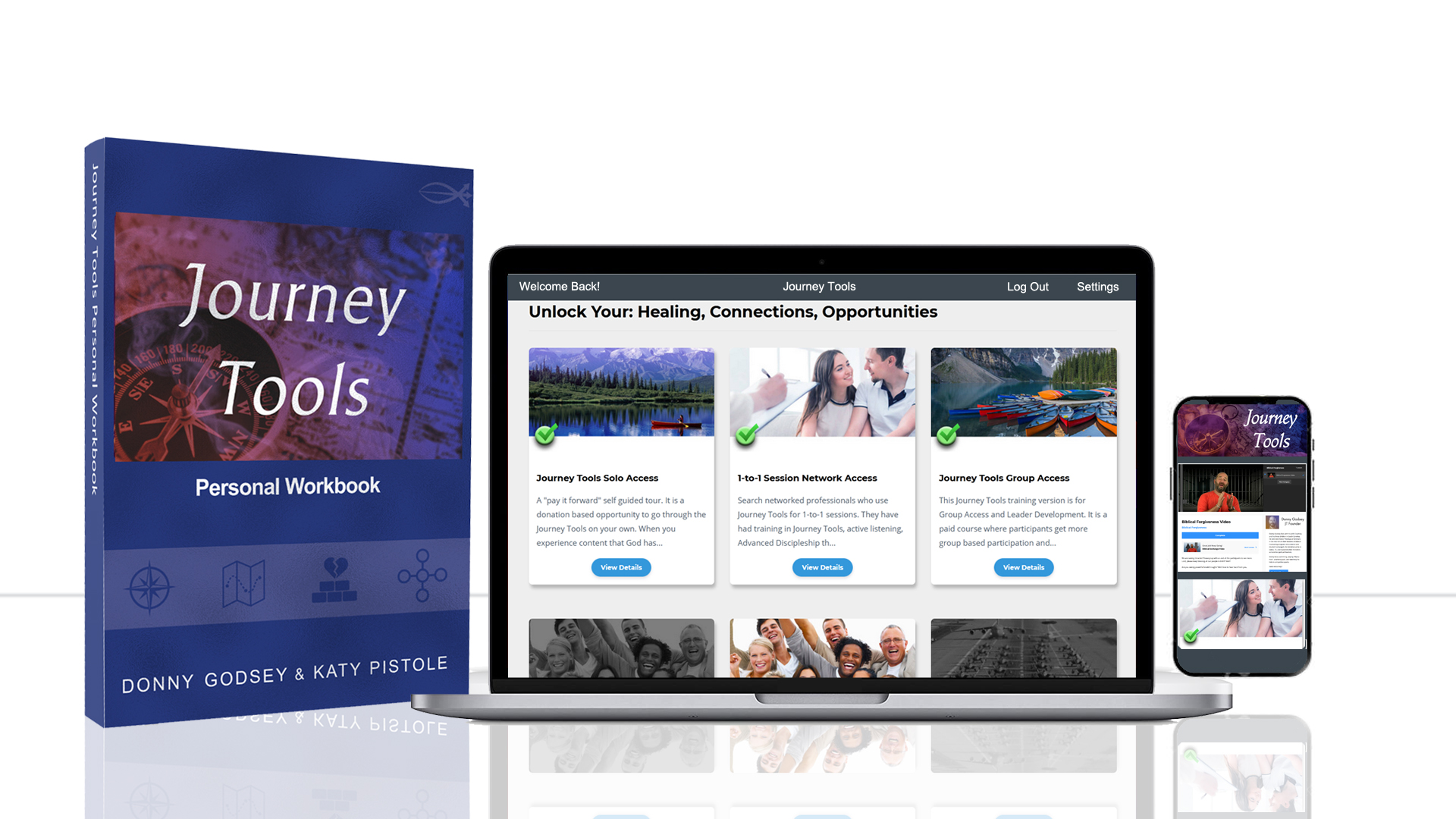
Participants have loved how simple, entertaining, and impactful the material is.
The Journey Tools course was arranged for participants to see immediate traction as soon as possible. We did this by framing up the Biblical principles for asking God good questions, sharing the story of Donny's family crisis moment and God's response, and then continuing with a simple highly effective first tool set.
"That first week changed what I thought was even possible and I've been a praying Christian for over 30 years!"
That initial "WOW!" helps give curiosity and courage for the rest of the course where we cover several challenging subjects including grief, trauma, addiction, and relationships.
Kick Off & Orientation:
We use this time to introduce a few core concepts such as the "God Ask", share participants' past experiences (with their permission), and frame up expectations for the group participation.
Compass Tools:
We dive into the 7 Compasses - designed to gather intel on our "now state." An essential awareness and first tool to understand for successfully navigating the rest of the material. The "emotional compass" seems to be a crowd favorite.
Permissions:
Permissions are like gated doorways. We later added this section in to help people address resistance to change and the healing process that often sabotages right intentions. This content was a total game changer by itself. Strategically placed before addressing the next week which equips us for healing our past.
FED Map:
FED stands for forgiveness, exchange, and declaration. Each of those Biblical processes are very important and powerful, but when used in the right order they are unbeatable for getting past your past. We cover a "map" of secondary issues that hide out behind unforgiveness that secretly anchor it down in our hearts. Walking through this process gives the darkness nowhere to hide. The "Lamp of Shame" is a favorite video from this section.
Building and Breaking Tools:
This section is divided into two parts: addiction and grief (and PTSD).
Addiction: The Biblical model for addiction is idolatry. The Bible has a lot to say about idolatry and its impact on our lives. We have the opportunity to tear our idols down and build up what the Lord wants in our lives. This illustrated model of addiction has been helping people see the underlying and supporting mechanics of addiction with new clarity and leverage as they use it to get free.
Grief (and PTSD): The 5 stages of grief (and recovery) are nothing new, but we unpack each stage not only with practical descriptions, but more importantly HOW to get out of them. Our journey through grief with God can actually be accelerated. We don't have to stay stuck in grief. Thought loss hurts, we simply are not perpetual victims to loss. Participants really like the "Complex Grief" video for getting a complicated topic into a new workable solution.
Relationships:
Trusting and Valuing God: We need to get our needs and issues sorted with God first before engaging others around us. So many relational problems come from not doing that FIRST. He is our protector, provider, sanctifier, and much more. This section has extremely practical theology about God, our identity in Christ, and what it means to rest in Him. "The Mystery of the Three Men" is a favorite video from this section.
Trusting and Valuing Others: When we carry a joyful overflow from our relationship with God, our relationship with others has a chance. Even so, using the "clover tool" or the "drop the rope" technique gives amazing leverage for coming together with friends and family members to face and fight challenges together from places of true oneness and victory.
Stories, samples, and next steps
Short Video Testimonials
High Impact Sample Videos
Quick Answers to
Frequently Asked Questions
We welcome your questions. Here are some common ones. If you have more, please reach out.
TOP QUESTION: Would it cost more to add Journey Tools to our current EAP offered to employees?
This is one of the best parts of our system. Our approach to care can be added on with no additional cost to your current EAP plan. Our solutions bypass traditional approaches to EAP funding to enable companies to offer care that better aligns with their priorities and values.
What is Journey Tools?
"It's all about asking God better questions... and follow up questions."
Journey Tools is a listening prayer and care approach that majors on Jesus being the Wonderful Counselor - He is present through His Word and Spirit and able to do more than human reasoning alone can do. Donny Godsey (CCM Founder and Journey Tools author) discovered that asking God strategic questions brought healing much faster than years of his own counseling training provided, both for himself and others.
The Journey Tools course covers many of the concepts and strategic questions used to efficiently address a variety common and difficult cases including grief, forgiveness, addiction, relationships, and more. Participants have found it well grounded in Biblical principles and immediately practical for addressing stubborn issues.
The focus for the group experience is engaging the material and sharing what the Lord is showing you. Participants have said this was far better than groups where people just dump their problems.
The material is simple enough to use with children and profound enough to stump theologians and experienced professionals. Check out sample content available on this site.
What is Cross Care Ministries?
Cross Care Ministries is the 501c3 nonprofit that schedules Journey Tools training, access and organizes EAP grant opportunities.
What is an EAP?
EAP stands for "Employee Assistance Program”. Originally developed in the 1930’s and 40’s as a means to help alcoholic issues in the workplace. By the 1980’s, corporate EAPs had expanded to include a much wider range of employee mental health.
Why would an EAP need help or need different care available?
EAPs over time had become another form of corporate insurance (a $3.6 billion a year industry), which was substantially more profitable the less people actually used it. In fact, pre-covid, as a national average, only 3% of employees used their company’s free mental health services via EAP for a variety of reasons: top of which was fear that it would get back to their HR departments or bosses and so the employees opted to pay for their own care out of pocket or skipped it entirely.
Case in point, research showed Georgia and North Carolina EAP counselors made only $24 an hour, which begs the question how good is the actual care when independent counseling commands 3 to 10 times higher fees.
According to the majority of employees and HR managers interviewed, they believed the EAP resources were subpar to what they wanted for addressing their home and workplace issues.
EAPs are a very good idea as a core concept, but desperately need rebuilding for why they exist and how they are interacted with to better serve their client companies and their employees.
How would Cross Care Ministries / Journey Tools be available in an EAP?
Cross Care Ministries and Journey Tools are available through partnering provider networks. If your EAP or care provider is not connected with us, let us know and we will sort out how to remedy that.
Peer led groups, 1-to-1 ministry, and self directed care are available.
Do we have to change EAP programs or providers?
In many cases, no. It is a simple add-on for those using our care model. We work out the service access at the EAP program end.
How long is the Journey Tools course?
The course is focused on equipping and typically done online as a 9 week training that involves video based homework and weekly online group discussion.
Many participants want to go through it again at a slower pace to try to capture more mastery of the material and leverage deeper transformation across more issues.